Engineered vs. Solid Hardwood in North Carolina: Which Handles Our Humidity Swings Better?
Oct 4, 2026
Written By Alvaro Ortiz | Owner of Ortiz Flooring Inc.
When evaluating natural wood floors for your home, comparing engineered hardwood vs solid hardwood is one of the most critical decisions you will make. Both options bring timeless architectural elegance, organic warmth, and lasting value to your living spaces. However, in North Carolina, choosing between them involves more than just aesthetics—it comes down to understanding how each construction type responds to regional environmental conditions.
As autumn progresses into October, NC weather begins its annual shift. Humidity levels drop outside, and as indoor heating systems turn on for the cooler months, indoor air becomes drier. This seasonal transition causes natural wood planks to contract, making fall the perfect time to understand how different hardwood constructions behave under fluctuating atmospheric conditions.
As your local flooring advisor, here is a complete guide to comparing engineered and solid timber so you can choose the best hardwood for NC climate demands and enjoy a lifetime of flawless beauty underfoot.
Understanding Hardwood Flooring Humidity Dynamics in NC
Natural wood is an organic, hygroscopic material. It continuously absorbs and releases moisture to maintain balance with the surrounding environment. When relative indoor humidity rises during our thick North Carolina summers, wood fibers absorb atmospheric moisture and expand. Conversely, during dry winter months when heating systems run continuously, wood releases moisture and contracts.
This seasonal movement is a natural property of timber. However, how a floor plank reacts to hardwood flooring humidity changes depends entirely on its internal physical structure:
Solid Hardwood: Milled from a single continuous piece of natural timber (typically 3/4" thick). Because all wood fibers run in the same direction, solid boards expand and contract uniformly across their width.
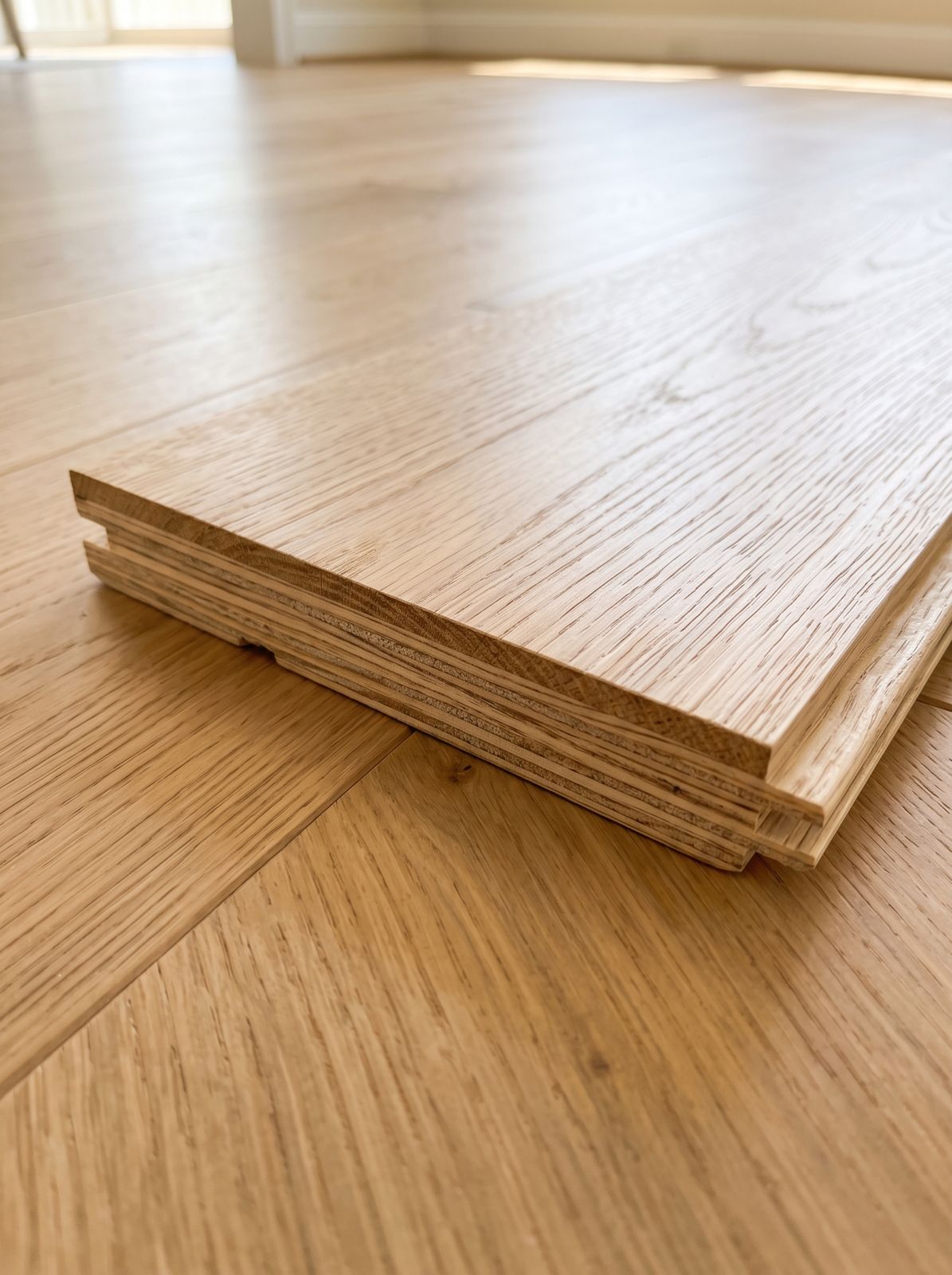
Engineered Hardwood: Features a top layer (wear layer) of authentic natural wood bonded over multiple cross-ply structural layers. These underlying core layers are laid in opposing directions, creating dimensional stability that helps minimize natural timber movement.
Solid Hardwood Flooring: The Timeless Heirloom
Solid wood has been the traditional gold standard of American architecture for centuries. It delivers a classic, continuous feel underfoot and represents a permanent structural asset in any home.
Key Characteristics of Solid Wood:
Authentic Heritage Feel: Milled entirely from solid timber species such as Oak, Hickory, or Maple, providing an heirloom aesthetic.
Generational Value: Solid planks can endure for generations when properly cared for in climate-controlled environments.
Installation Suitability: Performs best on or above grade over traditional wooden floor joists and wood subfloors.
While solid wood brings undeniable prestige, its single-piece construction means it experiences more pronounced expansion and contraction during North Carolina's seasonal humidity shifts. To explore why genuine timber remains a premier home upgrade, review our pillar guide on why genuine hardwood flooring remains the gold standard.
Engineered Hardwood Flooring: Built for Dimensional Stability
Many homeowners wonder: is engineered hardwood worth it compared to solid timber? Engineered wood was specifically developed to combine the authentic surface beauty of real wood with advanced dimensional stability.
Key Characteristics of Engineered Wood:
Authentic Wood Surface: The visible top surface is 100% genuine hardwood—showing identical grain patterns, natural variation, and rich textures as solid boards.
Cross-Ply Core Construction: The multi-layer core balances internal stress, helping minimize board expansion and contraction when humidity fluctuates.
Versatile Installation Placement: Enhanced dimensional stability allows engineered planks to be installed across multiple levels of your home, including concrete slabs and ground-level spaces, subject to proper moisture testing and manufacturer guidelines.
Engineered Hardwood vs. Solid Hardwood: Which Is Best for Your NC Home?
To determine the ideal fit for your specific property, evaluate where the floor will be installed and how your home manages seasonal moisture:
1. Foundation Type (Concrete Slab vs. Wood Subfloor)
If your home in Durham or Raleigh is built on a concrete slab foundation, engineered hardwood North Carolina installations are typically recommended. Concrete retains moisture vapor, and engineered wood's cross-ply core handles proximity to concrete far better than solid timber. For homes built over traditional wooden joist systems with wood subfloors, both solid and engineered options perform exceptionally well.
2. Indoor Climate Control & Seasonal Shifts
During October and the upcoming winter heating months, maintaining indoor relative humidity within the range recommended by the flooring manufacturer helps keep all natural wood stable. If your home experiences wider indoor humidity swings between seasons, engineered hardwood offers superior resistance against seasonal board gapping or swelling.
3. Room Location & Layout
For primary main levels, open-concept floor plans, and ground-level rooms, engineered planks provide smooth continuity across varying moisture zones. For formal dining rooms, second-story family spaces, or traditional estates in Wake Forest or Chapel Hill, solid hardwood offers an heirloom feel that complements historic architecture.
Making the Right Investment with Local Craftsmanship
Choosing between engineered and solid wood comes down to matching the material to your home's foundation, layout, and daily routine. Our team at Ortiz Flooring Inc. routinely installs engineered hardwood as well as solid timber across North Carolina homes. Whether you prefer classic solid oak or dimensional engineered planks, precision acclimation and proper installation ensure your floor stays flat, tight, and beautiful for decades.
At Ortiz Flooring Inc., we guide you through every stage of material selection and technical installation. Every residential project we manage is executed under The Peace of Mind Process, ensuring transparent communication, respectful jobsite care, and uncompromised craftsmanship from start to finish.
When searching for trusted hardwood flooring Durham NC specialists or local experts across the Triangle, partnering with experienced craftsmen ensures your investment is built on a solid foundation.
Location: Wortham St, Durham, NC — visits by appointment only.
Ready to Find the Perfect Hardwood Floor for Your Home?
Don't guess when it comes to choosing between solid and engineered hardwood. Visit us by appointment to view curated wood samples, evaluate your foundation type, and receive a clear, transparent estimate.
Five essential tips for North Carolina homeowners before replacing their floors: humidity, subfloors, solid vs. engineered hardwood, preparation, and DIY vs. a pro.
There is an undeniable, organic warmth to natural hardwood that synthetic surfaces simply cannot replicate. Real wood floors bring architectural elegance, natural variation, and permanent equity to North Carolina residences. Whether you are upgrading…
Small gaps that appear between hardwood boards during cold months and close up again when spring humidity returns are a normal part of seasonal wood movement. Because natural timber continuously adjusts to its surrounding environment, indoor heating during North Carolina’s winter season naturally causes boards to release moisture and shrink slightly underfoot. However, larger gaps that remain open year-round or show signs of board distortion deserve a thoughtful conversation with your original installer or the flooring manufacturer.
Read more
What Our Clients Say
“
I couldn't be happier with Ortiz Flooring. We are listing and needed carpets replaced and scratched on our difficult floor 'fixed' somehow. They offered to remove carpets before the painters came in…I couldn't be happier with Ortiz Flooring. We are listing and needed carpets replaced and scratched on our difficult floor 'fixed' somehow. They offered to remove carpets before the painters came in and do their job after. The carpet selection was very good quality, installation was fast and perfect. The owner returned after to complete the wood flooring touch ups which was not an easy job! I'm so happy with them and I'd select them in the future with no hesitation!
We had the pleasure of having Ortiz Flooring in Durham NC to install our luxury vinyl plank floors in our home. The crew did a magnificent job! They were very professional, knowledgeable, punctual…We had the pleasure of having Ortiz Flooring in Durham NC to install our luxury vinyl plank floors in our home. The crew did a magnificent job! They were very professional, knowledgeable, punctual, paid close attention to detail, cleaned up after themselves, and friendly!! The whole Team was great. Mr. Ortiz is so patient and kind as I was having a hard time making a decision on the floor. He was very helpful. Kristin the admin assistant was awesome with communicating with me via email with all the updates and was also very kind! She was a ray of sunshine.☀️ Haroldo and Alejandro were great installers!! They put down the shoe molding the best of anyone I have ever seen! Our floors turned out beautiful and we are thrilled with them! I would not hesitate to choose this Company again! Kudos to all of Ortiz Flooring! ⭐️⭐️⭐️⭐️⭐️
The whole Ortiz Flooring team was great to work with! I really appreciated Alvaro answering all my questions and helping me make the best choice based on what I needed, liked, and could afford. My…The whole Ortiz Flooring team was great to work with! I really appreciated Alvaro answering all my questions and helping me make the best choice based on what I needed, liked, and could afford. My carpet install was excellent and the team was really efficient! The price is really reasonable and their work is high quality. I will definitely be calling Ortiz Flooring again for future projects!
We had a great experience with Alvaro Ortiz. He was very professional. Got the work done very quickly and very well. We installed LVP flooring with him. Would definitely recommend and use him again…We had a great experience with Alvaro Ortiz. He was very professional. Got the work done very quickly and very well. We installed LVP flooring with him. Would definitely recommend and use him again in the future for any of our flooring needs!
They did an amazing job on our flooring job. We had a whole house project, including hardwood on the first floor, new carpet upstairs and hard flooring in the office. They also pulled up carpet from…They did an amazing job on our flooring job. We had a whole house project, including hardwood on the first floor, new carpet upstairs and hard flooring in the office. They also pulled up carpet from our stairs and replaced with wood. It is absolutely beautiful, and has changed the entire look of our home. They were professional, clean and communication was good. I would highly recommend!!!
I highly recommend Alvaro and his wonderful team! They met all my needs, and the new floor looks beautiful. Thank you, Kristin, for the clear pricing. And thank you, Diego and Max, for the amazing…I highly recommend Alvaro and his wonderful team! They met all my needs, and the new floor looks beautiful. Thank you, Kristin, for the clear pricing. And thank you, Diego and Max, for the amazing work!
Had a great experience with Ortiz Flooring! They installed hardwood in our entire upstairs before we moved into our new house. Things that stood out to me: They were able to get our floor installed…Had a great experience with Ortiz Flooring! They installed hardwood in our entire upstairs before we moved into our new house. Things that stood out to me: They were able to get our floor installed very quickly under time pressure of us needing to move in; Alvaro (the owner) and his team clearly want every job to be done right, a vanishingly rare trait in a contractor; there were height differences on a few planks, they returned and fixed immediately; their pricing is fair especially for the quality of their work; the floor is really beautiful, which, in the end is what matters. Additionally, in part I chose Ortiz because they are a local, family-run operation, trying to do good work at a fair price. Would strongly recommend, and I will use them myself in the future.
Alvaro and his team at Ortiz Flooring were absolutely first class from start to finish. They completely repaired the hardwood floors in our guest room and seamlessly matched the stain to the rest of…Alvaro and his team at Ortiz Flooring were absolutely first class from start to finish. They completely repaired the hardwood floors in our guest room and seamlessly matched the stain to the rest of the house and they finished the whole job in just 3 days. The crew was courteous, professional, and prompt every step of the way, and the craftsmanship speaks for itself. If you're looking for a flooring team that treats your home like their own and delivers exceptional work on time, look no further. Ortiz Flooring has earned my business for life! Highly, highly recommend.
Alvaro got me on his calendar almost immediately. The service was quick and efficient!! I let them work on two rooms while I was at work, which was really nice. The guys replaced the subfloor…Alvaro got me on his calendar almost immediately. The service was quick and efficient!! I let them work on two rooms while I was at work, which was really nice. The guys replaced the subfloor, installed new LVP, baseboards, and quarter round. It looks amazing! Very reasonable price for the job
Had a great experience with Ortiz Flooring! They installed hardwood in our entire upstairs before we moved into our new house. Things that stood out to me: They were able to get our floor installed…Had a great experience with Ortiz Flooring! They installed hardwood in our entire upstairs before we moved into our new house. Things that stood out to me: They were able to get our floor installed very quickly under time pressure of us needing to move in; Alvaro (the owner) and his team clearly want every job to be done right, a vanishingly rare trait in a contractor; there were height differences on a few planks, they returned and fixed immediately; their pricing is fair especially for the quality of their work; the floor is really beautiful, which, in the end is what matters. Additionally, in part I chose Ortiz because they are a local, family-run operation, trying to do good work at a fair price. Would strongly recommend, and I will use them myself in the future.
Alvaro and his team at Ortiz Flooring were absolutely first class from start to finish. They completely repaired the hardwood floors in our guest room and seamlessly matched the stain to the rest of…Alvaro and his team at Ortiz Flooring were absolutely first class from start to finish. They completely repaired the hardwood floors in our guest room and seamlessly matched the stain to the rest of the house and they finished the whole job in just 3 days. The crew was courteous, professional, and prompt every step of the way, and the craftsmanship speaks for itself. If you're looking for a flooring team that treats your home like their own and delivers exceptional work on time, look no further. Ortiz Flooring has earned my business for life, they're who I'll call for anything we need going forward. Highly, highly recommend.
We had a really great experience with Ortiz flooring! We needed our oak floors refinished and they did a really beautiful job. They actually went above and beyond what we originally asked and all for…We had a really great experience with Ortiz flooring! We needed our oak floors refinished and they did a really beautiful job. They actually went above and beyond what we originally asked and all for a very reasonable price. They filled in all the gaps, repaired damaged boards, and even let us use a stain that we already had to help us save some money we'd spent already on the project. It really became apparent to us how great of a job they did when we would visit our friends and family that just had their floor redone and it would already be scratched up or didn't really look finished unlike ours! We would absolutely use them again!
We had our upper floor carpet replaced with LVP from these recently and they were amazing! Workers were super nice and quick, the managing/coordinating staff were extremely friendly, and they wanted…We had our upper floor carpet replaced with LVP from these recently and they were amazing! Workers were super nice and quick, the managing/coordinating staff were extremely friendly, and they wanted to make sure we absolutely loved our floors before closing things out. 10/10 experience!
My floors look perfect. I chose to let Ortiz crew work on my home when I was at work and it was great to come home to the finished product! I had some concerns about previous moisture damage and they…My floors look perfect. I chose to let Ortiz crew work on my home when I was at work and it was great to come home to the finished product! I had some concerns about previous moisture damage and they took care of that before finishing the install. Every part of this process was easy and I'll be using Ortiz for future projects.
Álvaro and his team at Ortiz did an awesome job replacing my carpet upstairs and installing hardwoods in two downstairs bedrooms. Everything looks flawless. They matched the stain of the existing…Álvaro and his team at Ortiz did an awesome job replacing my carpet upstairs and installing hardwoods in two downstairs bedrooms. Everything looks flawless. They matched the stain of the existing hardwoods perfectly. The communication from Álvaro and his office staff was always prompt, friendly, and professional. I would choose this company to do any future flooring projects without hesitation.
We had our flooring changed to lvp and install new carpet! Alvaro provided a very reasonable price from all the other company i have asked for an estimate. They are easy to work with and know what…We had our flooring changed to lvp and install new carpet! Alvaro provided a very reasonable price from all the other company i have asked for an estimate. They are easy to work with and know what they are doing. I would recommend them to anyone.
Alvaro and his team were fantastic! We love how our floors came out, he made the entire experience seamless. I recommend letting him give a quote if you’re trying to get your floors re-done.
WouId I use them again? Absolutely! Would I recomment them to my mom? Absolutely! They were fair in pricing, dependable, on time, excellent skillwise, and cleaned up after themselves (I can't say…WouId I use them again? Absolutely! Would I recomment them to my mom? Absolutely! They were fair in pricing, dependable, on time, excellent skillwise, and cleaned up after themselves (I can't say this for other projects/companies which is why I mention it.). Alvaro was very professional and listened to me and my needs. I had the entire 2-story home of flooring done and I can't say a single negative thing. Thank you so much!
Ortiz Flooring was absolutely great to work with! Easy to communicate and coordinate with and very attentive to the needs of our project. They installed a Forbo Marmoleum tile floor in our garage so…Ortiz Flooring was absolutely great to work with! Easy to communicate and coordinate with and very attentive to the needs of our project. They installed a Forbo Marmoleum tile floor in our garage so swiftly and seamlessly and we could not be happier with the results. We will definitely work with them again. High recommend.
My experience at every step of the process was exactly what one would expect from a professional. I submitted a request for a quote and received a quick response to schedule an onsite appraisal…My experience at every step of the process was exactly what one would expect from a professional. I submitted a request for a quote and received a quick response to schedule an onsite appraisal shortly thereafter. Alvaro came for a consult that was efficient, informative and kind. When I decided to go forward with Ortiz Flooring, the process was very efficient: there were no gaps in communication and they acknowledged all down payments. Their communication was the best I’ve ever seen—that’s very reassuring. They notified me when materials were received. And the install exceeded expectations-it took only one day (small job) when I expected it might run over. Alvaro’s crew worked efficiently and well: they take very good care that all is done well and any loose ends are swiftly secured. Thank you. That kind of service is rare.
We are selling our house and needed carpet replaced asap. Our realtor recommended Ortiz Flooring. They came out for a quote within an hour of contacting them, gave me a quote on the spot and were…We are selling our house and needed carpet replaced asap. Our realtor recommended Ortiz Flooring. They came out for a quote within an hour of contacting them, gave me a quote on the spot and were able to fit us in a few days later. They were in and out the same day, moved all our furniture, cleaned up, and did an amazing job! I highly recommend!
We used Ortiz flooring to replace our old carpet and install LVP in our bathrooms. The team were punctual, hard working and the quality of the installation was excellent.
We had an excellent experience with this flooring company from start to finish. After a dishwasher leak damaged the wood flooring around our kitchen island, we needed a repair that would blend…We had an excellent experience with this flooring company from start to finish. After a dishwasher leak damaged the wood flooring around our kitchen island, we needed a repair that would blend seamlessly with the rest of our home. Not only did they replace the affected area, but they also sanded and stained the entire first floor to ensure a perfect match—and the results were flawless. Their team was professional, respectful, and always on time. Communication throughout the process was clear and consistent, which made everything much less stressful. We were so impressed with the quality of their work that we hired them to refinish our stairs, and they did another outstanding job. If you’re looking for a company that truly takes pride in their craftsmanship and customer service, I highly recommend them.
I can’t say enough about Ortiz Flooring! His crew did an absolutely amazing job. They completed our floors in just one day, with incredible attention to detail. They even took care of removing and…I can’t say enough about Ortiz Flooring! His crew did an absolutely amazing job. They completed our floors in just one day, with incredible attention to detail. They even took care of removing and discarding the old floors, making the whole process completely stress-free. The new floors look stunning, exactly what we hoped for and more. I highly recommend Ortiz Flooring to anyone looking for quality, professionalism, and beautiful results!
After submitting a request online the owner contacted me directly, was quick to schedule an appointment to review my repair job and provided a quote on the spot. Scheduling the work was quick and…After submitting a request online the owner contacted me directly, was quick to schedule an appointment to review my repair job and provided a quote on the spot. Scheduling the work was quick and easy (made it within the same week as the quote - though I did already have replacement flooring on hand). The team showed up for the job on time and were very quick to complete, with the repair looking seamless within the existing floor. I am overall very happy with the work from Ortiz!
We purchased our house 1.5 yrs ago. LOTS of work to be done, with many projects as DIY and some outsourced. Therefore, we consider the ROI on each project. Our Goal: Replace heavily trafficked carpet…We purchased our house 1.5 yrs ago. LOTS of work to be done, with many projects as DIY and some outsourced. Therefore, we consider the ROI on each project. Our Goal: Replace heavily trafficked carpet areas -family room, stairs & upstairs hall with LVP. From start to finish, communication with Alvaro (owner) and Kristin (Administrative Assistant), was excellent. Emails were responded to within minutes or at most a few hours. We liked the flexibility of our purchasing the LVP through Lowes, and using my husband’s veteran discount. Ortiz flooring picked up order.
I wanted to remove a small area of tile and replace it with hardwood flooring to match the existing hardwoods. Although the existing flooring was over 15 years old, Ortiz Flooring matched it…I wanted to remove a small area of tile and replace it with hardwood flooring to match the existing hardwoods. Although the existing flooring was over 15 years old, Ortiz Flooring matched it perfectly. The quote was complete and easy to understand. The craftsmen were talented, professional, and polite. The work was completed on the promised timeline. It was a great experience. I highly recommend Ortiz Flooring.
Had some water damage in a bathroom that required repair. After submitting a request online the business owner reached out quickly and setup a consolut. He was punctual and very helpful to quickly…Had some water damage in a bathroom that required repair. After submitting a request online the business owner reached out quickly and setup a consolut. He was punctual and very helpful to quickly review the work and provide a quote. The team was able to come out same week (I had the material in house already) and finish the job quickly. Overall I was very happy with the work and quick response from the team.
Alvaro stretched our carpet in 3 rooms and also did repair on our hardwood floors. The team he sent to do the job were highly skilled, paid attention to detail, and did an incredible job on both the…Alvaro stretched our carpet in 3 rooms and also did repair on our hardwood floors. The team he sent to do the job were highly skilled, paid attention to detail, and did an incredible job on both the carpet and hardwood. The hardwood repair was not easy and yet they were smart in how they approached it, really cared about the aesthetics and cleaned up really well. They took pride in their work, which you don't often see.
I am pleased with Ortiz Flooring services replacing our second floor carpet. Mr. Ortiz was helpful in scheduling, discussing alternatives and providing samples. For us this step can sometimes be…I am pleased with Ortiz Flooring services replacing our second floor carpet. Mr. Ortiz was helpful in scheduling, discussing alternatives and providing samples. For us this step can sometimes be difficult and Mr Ortiz made it pleasant and effective. Diego and his crew arrived as scheduled and worked well as a team. They did a beautiful installation and clean up of old carpet and other debris. Diego's team were professional and courteous. The quality of carpet, installation and fair pricing is impressive. We enjoyed working with Ortiz Flooring and plan to use them for our next project.
We are very happy with our new flooring. The quality is excellent, and it completely changed the look of our home. Installation was done professionally and on time. It’s easy to clean and looks…We are very happy with our new flooring. The quality is excellent, and it completely changed the look of our home. Installation was done professionally and on time. It’s easy to clean and looks beautiful. Highly recommend!
Mr Ortiz was very patient and professional in answering my many questions about our floor replacement plans. Was able to adjust as our plans evolved. His crews were polite and very thorough. Would…Mr Ortiz was very patient and professional in answering my many questions about our floor replacement plans. Was able to adjust as our plans evolved. His crews were polite and very thorough. Would use again.
I am pleased with Ortiz Flooring services replacing our second floor carpet. Mr. Ortiz was helpful in scheduling, discussing alternatives and providing samples. For us this step can sometimes be…I am pleased with Ortiz Flooring services replacing our second floor carpet. Mr. Ortiz was helpful in scheduling, discussing alternatives and providing samples. For us this step can sometimes be difficult and Mr Ortiz made it pleasant and effective. Ortiz and his crew arrived as scheduled and worked well as a team. They did a beautiful installation and clean up of old carpet and other debris. Ortiz's team were professional and courteous. The quality of carpet, installation and fair pricing is impressive. We enjoyed working with Ortiz Flooring and plan to use the
Mr. Ortiz listened carefully to me and clearly explained flooring products to me so I could make the best decision for my home. His crew was on time, polite and courteous. I was impressed with their…Mr. Ortiz listened carefully to me and clearly explained flooring products to me so I could make the best decision for my home. His crew was on time, polite and courteous. I was impressed with their organization and efficiency of tasks to remove old flooring and install new flooring. Great pricing and excellent service ! !
Alvaro and his crew were kind, knowledgeable, prompt, and meticulous. He was able to squeeze our project in before the holidays and our home looks beautiful! Thank you!
Mr. Ortiz and his crew were kind, knowledgeable, prompt, and meticulous. He was able to squeeze our project in before the holidays and our home looks beautiful! Thank you!
Tuvimos una excelente experiencia con Álvaro de Ortiz Flooring. Hay muchas opciones excelentes en la sala de exposición y son muy profesionales. Lo recomiendo ampliamente.
I am so pleased with Ortiz Flooring. Alvaro the owner came to our house for quote and he brought samples. The job was done when and as contractor stated and looks great! Highly recommend for your…I am so pleased with Ortiz Flooring. Alvaro the owner came to our house for quote and he brought samples. The job was done when and as contractor stated and looks great! Highly recommend for your flooring needs
We recently had the pleasure of working with Ortiz Flooring Company, and we couldnt be happier with the results! Their team did an absolutely excellent job professional, detail-oriented, and…We recently had the pleasure of working with Ortiz Flooring Company, and we couldnt be happier with the results! Their team did an absolutely excellent job professional, detail-oriented, and efficient from start to finish. The craftsmanship and quality of the work exceeded our expectations. They were respectful of our space, cleaned up thoroughly, and delivered everything on time. If youre looking for reliable and skilled flooring experts, Ortiz Flooring is the one to call! Highly recommended!
Craftsmanship & Customer Service Still Exist! Background – We purchased our house 1.5 yrs ago. LOTS of work to be done, with many projects as DIY and some outsourced. Therefore, we consider the ROI…Craftsmanship & Customer Service Still Exist! Background – We purchased our house 1.5 yrs ago. LOTS of work to be done, with many projects as DIY and some outsourced. Therefore, we consider the ROI on each project. Our Goal: Replace heavily trafficked carpet areas -family room, stairs & upstairs hall with LVP. From start to finish, communication with Alvaro (owner) and Kristin (Administrative Assistant), was excellent. Emails were responded to within minutes or at most a few hours. We liked the flexibility of our purchasing the LVP through Lowes, and using my husband’s veteran discount. Ortiz flooring picked up order. Diego and Adrian were the two young men who removed old carpeting, installed the underlayment, LVP, quarter round molding, new risers & painted. What a work ethic! They were extremely conscientious, pleasant, and made sure every measurement was correct. If not quite right, a piece was re-cut. The job took two days. Note to Photos: I was so busy painting the Family Room, I forgot to take before shot. Huge improvement though. Bottomline – Would we use Ortiz Flooring again? Absolutely!
I had an excellent experience with Ortiz Flooring! From start to finish, their team was professional, efficient, and highly skilled. They expertly removed old carpet and damaged engineered hardwood…I had an excellent experience with Ortiz Flooring! From start to finish, their team was professional, efficient, and highly skilled. They expertly removed old carpet and damaged engineered hardwood, leveling the concrete to perfection before installing stunning luxury vinyl plank (LVP) flooring throughout our home. The attention to detail was remarkable, and the end result is absolutely beautiful. Their dedication to quality and customer satisfaction was evident every step of the way. I couldn’t be happier with their work and would highly recommend them to anyone looking for high-quality flooring services!