Why Do Hardwood Floors Gap in Winter? What Triangle Homeowners Should Know
Nov 6, 2026
Written By Alvaro Ortiz | Owner of Ortiz Flooring Inc.
Small gaps that appear between hardwood boards during cold months and close up again when spring humidity returns are a normal part of seasonal wood movement. Because natural timber continuously adjusts to its surrounding environment, indoor heating during North Carolina’s winter season naturally causes boards to release moisture and shrink slightly underfoot. However, larger gaps that remain open year-round or show signs of board distortion deserve a thoughtful conversation with your original installer or the flooring manufacturer.
During home consultations across Durham, Raleigh, Cary, Apex, Morrisville, and Fuquay-Varina, one of the most common calls I receive every November and December comes from homeowners asking: “Alvaro, I just noticed tiny spaces opening up between my hardwood boards. Is my floor falling apart?”
Seeing micro-gaps between your floorboards once central heating turns on can be unsettling, especially if your floor was installed during humid summer months. Fortunately, understanding how natural timber responds to seasonal moisture shifts helps you protect your investment, maintain comfortable indoor conditions, and know exactly what to expect from your floors all year long.
Here is an honest contractor’s guide to why hardwood floors shrink in winter, what indoor humidity targets to aim for, and how to care for your wood floors during North Carolina’s colder season.
Why Wood Moves: The Science of Winter Shrinkage
Natural timber is an organic, hygroscopic material—meaning it naturally absorbs and releases moisture vapor to stay in equilibrium with the air around it.
During humid North Carolina summers, atmospheric moisture enters your home. Natural wood fibers absorb this ambient humidity and expand slightly across the width of each board. When cold weather arrives across the NC Triangle, central heating systems run continuously throughout December, January, and February. This heating process lowers indoor relative humidity, drying out the air inside your living spaces.
As indoor air becomes dry, wood planks gradually release their stored moisture back into the room. Because timber shrinks across its grain as it dries, tiny gaps can naturally form between individual floorboards. To understand how North Carolina’s climate transitions affect your home over time, review our guide on summer to autumn flooring transitions.
What Indoor Humidity to Aim for in Your Home
Managing indoor humidity for hardwood floors is the single most effective way to minimize seasonal board movement. However, ideal humidity ranges depend on industry standards and, most importantly, your specific product line.
Manufacturers provide reference guidelines for indoor climate control:
Typical Manufacturer Range: Many wood flooring manufacturers specify a relative humidity range of roughly 30% to 55% within a temperature window of 60°F to 80°F to maintain product performance.
The Crucial Rule: General industry guidelines serve as helpful benchmarks, but the specific installation and care instructions from your floor’s manufacturer always prevail. Flooring warranties and structural performance depend strictly on adhering to the specific humidity and temperature parameters outlined by the product’s manufacturer.
What to Do This Winter: Practical Care for Your Floors
If you notice seasonal gaps forming between your floorboards this winter, several practical steps can help maintain indoor comfort and protect your surface finish:
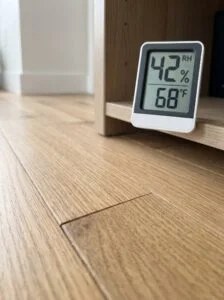
Monitor Your Indoor Air with a Hygrometer: Place a simple digital hygrometer in your main living space to track daily relative humidity levels. If your indoor humidity drops significantly below manufacturer recommendations, you know dry air is actively pulling moisture from your floor.
Use a Whole-Home or Portable Humidifier: Running a humidifier during dry winter months helps add controlled moisture back into the air. This can slow timber contraction and reduce board gapping. Be careful not to over-humidify, as excessive moisture can create other indoor environmental issues.
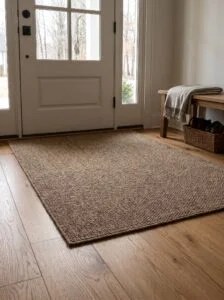
Place Protective Entry Mats and Rugs: Winter brings rain, slush, and abrasive grit onto shoe treads. Position breathable entry mats at exterior doorways to trap debris before it reaches your living spaces.
Wipe Up Water Spills and Wet Paws Promptly: While dry winter air causes shrinking, standing water near entryways or kitchen sinks can cause localized board swelling or finish stress. Always dry accidental liquid spills immediately.
For a broader look at how different materials and subfloor underlayments perform during colder weather, explore our seasonal guide on keeping your feet warm this winter.
How a Proper Installation Reduces Seasonal Movement
While no installation can eliminate natural wood movement entirely, professional preparation minimizes how severely boards react to seasonal shifts:
Climate Acclimation & Pre-Installation Testing: Before a single board is fastened, verifying indoor atmospheric conditions and following manufacturer acclimation requirements allows wood planks to adjust to your home’s baseline environment.
Solid vs. Engineered Hardwood Performance: Solid timber (milled from a single continuous piece of 3/4″ wood) expands and contracts uniformly across its width. By contrast, engineered hardwood features a natural wood veneer bonded over cross-ply core layers, offering enhanced dimensional stability against humidity shifts. However, engineered planks in extremely dry conditions can occasionally experience dry-cupping if relative humidity drops too low. To evaluate which construction fits your foundation best, explore our technical breakdown on engineered vs. solid hardwood in North Carolina.
Regardless of whether you choose solid or engineered planks, genuine wood remains a timeless choice. To explore the lasting benefits of natural timber, read our pillar guide on why genuine hardwood flooring remains the gold standard.
Every residential project we manage is executed through The Peace of Mind Process. Our structured process focuses on clear written estimates, moisture testing, dust-control protocols, and clean execution from start to finish.
When to Ask for Professional Guidance
Not all floorboard gaps are purely seasonal. It is helpful to know when gaps are part of normal winter movement and when they indicate a condition requiring further evaluation:
Seasonal Gaps (Normal): Thin, uniform hairline spaces that appear during dry winter heating months and close smoothly as spring and summer humidity return.
Persistent or Irregular Gaps (Deserves Attention): Wide gaps that remain wide open during humid summer months, or boards that show severe cupping, buckling, or edge lifting.
If your gaps do not close during humid months or if you notice structural board distortion, reach out directly to your original flooring installer or the flooring manufacturer to review your floor’s condition and manufacturer warranty guidelines.
Frequently Asked Questions About Winter Hardwood Gaps
Is it normal for hardwood to have gaps in winter?
Yes. Hairline gaps between wood planks during winter heating months are a natural response to drier indoor air. As long as the gaps are relatively uniform and close up when warmer, humid spring weather returns, this movement is considered normal timber behavior.
What humidity level does hardwood need?
Many flooring manufacturers suggest keeping relative indoor humidity between roughly 30% and 55% at temperatures between 60°F and 80°F. Always check the specific owner’s manual and warranty guidelines for your exact flooring product.
Does using a humidifier help hardwood floors in winter?
Yes. Operating a humidifier during dry winter months helps maintain indoor moisture levels within manufacturer-recommended ranges. This can reduce the severity of winter board shrinkage and help keep floorboard joints tighter.
Regional Expertise for NC Homes
Whether you are living in a historic property in Durham, a suburban home in Morrisville, or a growing neighborhood in Fuquay-Varina, understanding how your home’s climate interacts with natural timber ensures your floors remain comfortable and beautiful.
To explore how natural wood integrates into your local community, review our localized guide on hardwood flooring in Durham, NC.
Location: Wortham St, Durham, NC — visits by appointment only.
Have Questions About Your Hardwood Floors This Winter?
If you are planning a new hardwood installation or want professional guidance on selecting the right wood construction for your home’s foundation, our team is here to help. Visit us by appointment or schedule an in-home consultation to view material samples and receive a clear written estimate.
As November brings cooler temperatures across the North Carolina Triangle, HVAC systems shift from cooling to heating, and indoor moisture levels drop. For homeowners in Durham, Raleigh, and surrounding areas, winter brings a shift in how we experience our homes underfoot.
As autumn progresses and cooler weather settles over North Carolina, we naturally spend more time indoors. Our daily focus shifts toward creating a cozy, restful environment—especially in upper-level bedrooms, home offices, and hallways where…
When homeowners ask me about upgrading their living spaces, hardwood flooring Durham NC searches often reflect a desire for natural warmth, architectural character, and enduring appeal. Over my two decades as a flooring contractor, I have worked with homeowners throughout Durham, including Trinity Park, Hope Valley, Old West Durham, and Southpoint. One constant remains unchanged: genuine wood floors continue to define fine North Carolina interiors.
Read more
What Our Clients Say
“
I couldn't be happier with Ortiz Flooring. We are listing and needed carpets replaced and scratched on our difficult floor 'fixed' somehow. They offered to remove carpets before the painters came in…I couldn't be happier with Ortiz Flooring. We are listing and needed carpets replaced and scratched on our difficult floor 'fixed' somehow. They offered to remove carpets before the painters came in and do their job after. The carpet selection was very good quality, installation was fast and perfect. The owner returned after to complete the wood flooring touch ups which was not an easy job! I'm so happy with them and I'd select them in the future with no hesitation!
We had the pleasure of having Ortiz Flooring in Durham NC to install our luxury vinyl plank floors in our home. The crew did a magnificent job! They were very professional, knowledgeable, punctual…We had the pleasure of having Ortiz Flooring in Durham NC to install our luxury vinyl plank floors in our home. The crew did a magnificent job! They were very professional, knowledgeable, punctual, paid close attention to detail, cleaned up after themselves, and friendly!! The whole Team was great. Mr. Ortiz is so patient and kind as I was having a hard time making a decision on the floor. He was very helpful. Kristin the admin assistant was awesome with communicating with me via email with all the updates and was also very kind! She was a ray of sunshine.☀️ Haroldo and Alejandro were great installers!! They put down the shoe molding the best of anyone I have ever seen! Our floors turned out beautiful and we are thrilled with them! I would not hesitate to choose this Company again! Kudos to all of Ortiz Flooring! ⭐️⭐️⭐️⭐️⭐️
The whole Ortiz Flooring team was great to work with! I really appreciated Alvaro answering all my questions and helping me make the best choice based on what I needed, liked, and could afford. My…The whole Ortiz Flooring team was great to work with! I really appreciated Alvaro answering all my questions and helping me make the best choice based on what I needed, liked, and could afford. My carpet install was excellent and the team was really efficient! The price is really reasonable and their work is high quality. I will definitely be calling Ortiz Flooring again for future projects!
We had a great experience with Alvaro Ortiz. He was very professional. Got the work done very quickly and very well. We installed LVP flooring with him. Would definitely recommend and use him again…We had a great experience with Alvaro Ortiz. He was very professional. Got the work done very quickly and very well. We installed LVP flooring with him. Would definitely recommend and use him again in the future for any of our flooring needs!
They did an amazing job on our flooring job. We had a whole house project, including hardwood on the first floor, new carpet upstairs and hard flooring in the office. They also pulled up carpet from…They did an amazing job on our flooring job. We had a whole house project, including hardwood on the first floor, new carpet upstairs and hard flooring in the office. They also pulled up carpet from our stairs and replaced with wood. It is absolutely beautiful, and has changed the entire look of our home. They were professional, clean and communication was good. I would highly recommend!!!
I highly recommend Alvaro and his wonderful team! They met all my needs, and the new floor looks beautiful. Thank you, Kristin, for the clear pricing. And thank you, Diego and Max, for the amazing…I highly recommend Alvaro and his wonderful team! They met all my needs, and the new floor looks beautiful. Thank you, Kristin, for the clear pricing. And thank you, Diego and Max, for the amazing work!
Had a great experience with Ortiz Flooring! They installed hardwood in our entire upstairs before we moved into our new house. Things that stood out to me: They were able to get our floor installed…Had a great experience with Ortiz Flooring! They installed hardwood in our entire upstairs before we moved into our new house. Things that stood out to me: They were able to get our floor installed very quickly under time pressure of us needing to move in; Alvaro (the owner) and his team clearly want every job to be done right, a vanishingly rare trait in a contractor; there were height differences on a few planks, they returned and fixed immediately; their pricing is fair especially for the quality of their work; the floor is really beautiful, which, in the end is what matters. Additionally, in part I chose Ortiz because they are a local, family-run operation, trying to do good work at a fair price. Would strongly recommend, and I will use them myself in the future.
Alvaro and his team at Ortiz Flooring were absolutely first class from start to finish. They completely repaired the hardwood floors in our guest room and seamlessly matched the stain to the rest of…Alvaro and his team at Ortiz Flooring were absolutely first class from start to finish. They completely repaired the hardwood floors in our guest room and seamlessly matched the stain to the rest of the house and they finished the whole job in just 3 days. The crew was courteous, professional, and prompt every step of the way, and the craftsmanship speaks for itself. If you're looking for a flooring team that treats your home like their own and delivers exceptional work on time, look no further. Ortiz Flooring has earned my business for life! Highly, highly recommend.
Alvaro got me on his calendar almost immediately. The service was quick and efficient!! I let them work on two rooms while I was at work, which was really nice. The guys replaced the subfloor…Alvaro got me on his calendar almost immediately. The service was quick and efficient!! I let them work on two rooms while I was at work, which was really nice. The guys replaced the subfloor, installed new LVP, baseboards, and quarter round. It looks amazing! Very reasonable price for the job
Had a great experience with Ortiz Flooring! They installed hardwood in our entire upstairs before we moved into our new house. Things that stood out to me: They were able to get our floor installed…Had a great experience with Ortiz Flooring! They installed hardwood in our entire upstairs before we moved into our new house. Things that stood out to me: They were able to get our floor installed very quickly under time pressure of us needing to move in; Alvaro (the owner) and his team clearly want every job to be done right, a vanishingly rare trait in a contractor; there were height differences on a few planks, they returned and fixed immediately; their pricing is fair especially for the quality of their work; the floor is really beautiful, which, in the end is what matters. Additionally, in part I chose Ortiz because they are a local, family-run operation, trying to do good work at a fair price. Would strongly recommend, and I will use them myself in the future.
Alvaro and his team at Ortiz Flooring were absolutely first class from start to finish. They completely repaired the hardwood floors in our guest room and seamlessly matched the stain to the rest of…Alvaro and his team at Ortiz Flooring were absolutely first class from start to finish. They completely repaired the hardwood floors in our guest room and seamlessly matched the stain to the rest of the house and they finished the whole job in just 3 days. The crew was courteous, professional, and prompt every step of the way, and the craftsmanship speaks for itself. If you're looking for a flooring team that treats your home like their own and delivers exceptional work on time, look no further. Ortiz Flooring has earned my business for life, they're who I'll call for anything we need going forward. Highly, highly recommend.
We had a really great experience with Ortiz flooring! We needed our oak floors refinished and they did a really beautiful job. They actually went above and beyond what we originally asked and all for…We had a really great experience with Ortiz flooring! We needed our oak floors refinished and they did a really beautiful job. They actually went above and beyond what we originally asked and all for a very reasonable price. They filled in all the gaps, repaired damaged boards, and even let us use a stain that we already had to help us save some money we'd spent already on the project. It really became apparent to us how great of a job they did when we would visit our friends and family that just had their floor redone and it would already be scratched up or didn't really look finished unlike ours! We would absolutely use them again!
We had our upper floor carpet replaced with LVP from these recently and they were amazing! Workers were super nice and quick, the managing/coordinating staff were extremely friendly, and they wanted…We had our upper floor carpet replaced with LVP from these recently and they were amazing! Workers were super nice and quick, the managing/coordinating staff were extremely friendly, and they wanted to make sure we absolutely loved our floors before closing things out. 10/10 experience!
My floors look perfect. I chose to let Ortiz crew work on my home when I was at work and it was great to come home to the finished product! I had some concerns about previous moisture damage and they…My floors look perfect. I chose to let Ortiz crew work on my home when I was at work and it was great to come home to the finished product! I had some concerns about previous moisture damage and they took care of that before finishing the install. Every part of this process was easy and I'll be using Ortiz for future projects.
Álvaro and his team at Ortiz did an awesome job replacing my carpet upstairs and installing hardwoods in two downstairs bedrooms. Everything looks flawless. They matched the stain of the existing…Álvaro and his team at Ortiz did an awesome job replacing my carpet upstairs and installing hardwoods in two downstairs bedrooms. Everything looks flawless. They matched the stain of the existing hardwoods perfectly. The communication from Álvaro and his office staff was always prompt, friendly, and professional. I would choose this company to do any future flooring projects without hesitation.
We had our flooring changed to lvp and install new carpet! Alvaro provided a very reasonable price from all the other company i have asked for an estimate. They are easy to work with and know what…We had our flooring changed to lvp and install new carpet! Alvaro provided a very reasonable price from all the other company i have asked for an estimate. They are easy to work with and know what they are doing. I would recommend them to anyone.
Alvaro and his team were fantastic! We love how our floors came out, he made the entire experience seamless. I recommend letting him give a quote if you’re trying to get your floors re-done.
WouId I use them again? Absolutely! Would I recomment them to my mom? Absolutely! They were fair in pricing, dependable, on time, excellent skillwise, and cleaned up after themselves (I can't say…WouId I use them again? Absolutely! Would I recomment them to my mom? Absolutely! They were fair in pricing, dependable, on time, excellent skillwise, and cleaned up after themselves (I can't say this for other projects/companies which is why I mention it.). Alvaro was very professional and listened to me and my needs. I had the entire 2-story home of flooring done and I can't say a single negative thing. Thank you so much!
Ortiz Flooring was absolutely great to work with! Easy to communicate and coordinate with and very attentive to the needs of our project. They installed a Forbo Marmoleum tile floor in our garage so…Ortiz Flooring was absolutely great to work with! Easy to communicate and coordinate with and very attentive to the needs of our project. They installed a Forbo Marmoleum tile floor in our garage so swiftly and seamlessly and we could not be happier with the results. We will definitely work with them again. High recommend.
My experience at every step of the process was exactly what one would expect from a professional. I submitted a request for a quote and received a quick response to schedule an onsite appraisal…My experience at every step of the process was exactly what one would expect from a professional. I submitted a request for a quote and received a quick response to schedule an onsite appraisal shortly thereafter. Alvaro came for a consult that was efficient, informative and kind. When I decided to go forward with Ortiz Flooring, the process was very efficient: there were no gaps in communication and they acknowledged all down payments. Their communication was the best I’ve ever seen—that’s very reassuring. They notified me when materials were received. And the install exceeded expectations-it took only one day (small job) when I expected it might run over. Alvaro’s crew worked efficiently and well: they take very good care that all is done well and any loose ends are swiftly secured. Thank you. That kind of service is rare.
We are selling our house and needed carpet replaced asap. Our realtor recommended Ortiz Flooring. They came out for a quote within an hour of contacting them, gave me a quote on the spot and were…We are selling our house and needed carpet replaced asap. Our realtor recommended Ortiz Flooring. They came out for a quote within an hour of contacting them, gave me a quote on the spot and were able to fit us in a few days later. They were in and out the same day, moved all our furniture, cleaned up, and did an amazing job! I highly recommend!
We used Ortiz flooring to replace our old carpet and install LVP in our bathrooms. The team were punctual, hard working and the quality of the installation was excellent.
We had an excellent experience with this flooring company from start to finish. After a dishwasher leak damaged the wood flooring around our kitchen island, we needed a repair that would blend…We had an excellent experience with this flooring company from start to finish. After a dishwasher leak damaged the wood flooring around our kitchen island, we needed a repair that would blend seamlessly with the rest of our home. Not only did they replace the affected area, but they also sanded and stained the entire first floor to ensure a perfect match—and the results were flawless. Their team was professional, respectful, and always on time. Communication throughout the process was clear and consistent, which made everything much less stressful. We were so impressed with the quality of their work that we hired them to refinish our stairs, and they did another outstanding job. If you’re looking for a company that truly takes pride in their craftsmanship and customer service, I highly recommend them.
I can’t say enough about Ortiz Flooring! His crew did an absolutely amazing job. They completed our floors in just one day, with incredible attention to detail. They even took care of removing and…I can’t say enough about Ortiz Flooring! His crew did an absolutely amazing job. They completed our floors in just one day, with incredible attention to detail. They even took care of removing and discarding the old floors, making the whole process completely stress-free. The new floors look stunning, exactly what we hoped for and more. I highly recommend Ortiz Flooring to anyone looking for quality, professionalism, and beautiful results!
After submitting a request online the owner contacted me directly, was quick to schedule an appointment to review my repair job and provided a quote on the spot. Scheduling the work was quick and…After submitting a request online the owner contacted me directly, was quick to schedule an appointment to review my repair job and provided a quote on the spot. Scheduling the work was quick and easy (made it within the same week as the quote - though I did already have replacement flooring on hand). The team showed up for the job on time and were very quick to complete, with the repair looking seamless within the existing floor. I am overall very happy with the work from Ortiz!
We purchased our house 1.5 yrs ago. LOTS of work to be done, with many projects as DIY and some outsourced. Therefore, we consider the ROI on each project. Our Goal: Replace heavily trafficked carpet…We purchased our house 1.5 yrs ago. LOTS of work to be done, with many projects as DIY and some outsourced. Therefore, we consider the ROI on each project. Our Goal: Replace heavily trafficked carpet areas -family room, stairs & upstairs hall with LVP. From start to finish, communication with Alvaro (owner) and Kristin (Administrative Assistant), was excellent. Emails were responded to within minutes or at most a few hours. We liked the flexibility of our purchasing the LVP through Lowes, and using my husband’s veteran discount. Ortiz flooring picked up order.
I wanted to remove a small area of tile and replace it with hardwood flooring to match the existing hardwoods. Although the existing flooring was over 15 years old, Ortiz Flooring matched it…I wanted to remove a small area of tile and replace it with hardwood flooring to match the existing hardwoods. Although the existing flooring was over 15 years old, Ortiz Flooring matched it perfectly. The quote was complete and easy to understand. The craftsmen were talented, professional, and polite. The work was completed on the promised timeline. It was a great experience. I highly recommend Ortiz Flooring.
Had some water damage in a bathroom that required repair. After submitting a request online the business owner reached out quickly and setup a consolut. He was punctual and very helpful to quickly…Had some water damage in a bathroom that required repair. After submitting a request online the business owner reached out quickly and setup a consolut. He was punctual and very helpful to quickly review the work and provide a quote. The team was able to come out same week (I had the material in house already) and finish the job quickly. Overall I was very happy with the work and quick response from the team.
Alvaro stretched our carpet in 3 rooms and also did repair on our hardwood floors. The team he sent to do the job were highly skilled, paid attention to detail, and did an incredible job on both the…Alvaro stretched our carpet in 3 rooms and also did repair on our hardwood floors. The team he sent to do the job were highly skilled, paid attention to detail, and did an incredible job on both the carpet and hardwood. The hardwood repair was not easy and yet they were smart in how they approached it, really cared about the aesthetics and cleaned up really well. They took pride in their work, which you don't often see.
I am pleased with Ortiz Flooring services replacing our second floor carpet. Mr. Ortiz was helpful in scheduling, discussing alternatives and providing samples. For us this step can sometimes be…I am pleased with Ortiz Flooring services replacing our second floor carpet. Mr. Ortiz was helpful in scheduling, discussing alternatives and providing samples. For us this step can sometimes be difficult and Mr Ortiz made it pleasant and effective. Diego and his crew arrived as scheduled and worked well as a team. They did a beautiful installation and clean up of old carpet and other debris. Diego's team were professional and courteous. The quality of carpet, installation and fair pricing is impressive. We enjoyed working with Ortiz Flooring and plan to use them for our next project.
We are very happy with our new flooring. The quality is excellent, and it completely changed the look of our home. Installation was done professionally and on time. It’s easy to clean and looks…We are very happy with our new flooring. The quality is excellent, and it completely changed the look of our home. Installation was done professionally and on time. It’s easy to clean and looks beautiful. Highly recommend!
Mr Ortiz was very patient and professional in answering my many questions about our floor replacement plans. Was able to adjust as our plans evolved. His crews were polite and very thorough. Would…Mr Ortiz was very patient and professional in answering my many questions about our floor replacement plans. Was able to adjust as our plans evolved. His crews were polite and very thorough. Would use again.
I am pleased with Ortiz Flooring services replacing our second floor carpet. Mr. Ortiz was helpful in scheduling, discussing alternatives and providing samples. For us this step can sometimes be…I am pleased with Ortiz Flooring services replacing our second floor carpet. Mr. Ortiz was helpful in scheduling, discussing alternatives and providing samples. For us this step can sometimes be difficult and Mr Ortiz made it pleasant and effective. Ortiz and his crew arrived as scheduled and worked well as a team. They did a beautiful installation and clean up of old carpet and other debris. Ortiz's team were professional and courteous. The quality of carpet, installation and fair pricing is impressive. We enjoyed working with Ortiz Flooring and plan to use the
Mr. Ortiz listened carefully to me and clearly explained flooring products to me so I could make the best decision for my home. His crew was on time, polite and courteous. I was impressed with their…Mr. Ortiz listened carefully to me and clearly explained flooring products to me so I could make the best decision for my home. His crew was on time, polite and courteous. I was impressed with their organization and efficiency of tasks to remove old flooring and install new flooring. Great pricing and excellent service ! !
Alvaro and his crew were kind, knowledgeable, prompt, and meticulous. He was able to squeeze our project in before the holidays and our home looks beautiful! Thank you!
Mr. Ortiz and his crew were kind, knowledgeable, prompt, and meticulous. He was able to squeeze our project in before the holidays and our home looks beautiful! Thank you!
Tuvimos una excelente experiencia con Álvaro de Ortiz Flooring. Hay muchas opciones excelentes en la sala de exposición y son muy profesionales. Lo recomiendo ampliamente.
I am so pleased with Ortiz Flooring. Alvaro the owner came to our house for quote and he brought samples. The job was done when and as contractor stated and looks great! Highly recommend for your…I am so pleased with Ortiz Flooring. Alvaro the owner came to our house for quote and he brought samples. The job was done when and as contractor stated and looks great! Highly recommend for your flooring needs
We recently had the pleasure of working with Ortiz Flooring Company, and we couldnt be happier with the results! Their team did an absolutely excellent job professional, detail-oriented, and…We recently had the pleasure of working with Ortiz Flooring Company, and we couldnt be happier with the results! Their team did an absolutely excellent job professional, detail-oriented, and efficient from start to finish. The craftsmanship and quality of the work exceeded our expectations. They were respectful of our space, cleaned up thoroughly, and delivered everything on time. If youre looking for reliable and skilled flooring experts, Ortiz Flooring is the one to call! Highly recommended!
Craftsmanship & Customer Service Still Exist! Background – We purchased our house 1.5 yrs ago. LOTS of work to be done, with many projects as DIY and some outsourced. Therefore, we consider the ROI…Craftsmanship & Customer Service Still Exist! Background – We purchased our house 1.5 yrs ago. LOTS of work to be done, with many projects as DIY and some outsourced. Therefore, we consider the ROI on each project. Our Goal: Replace heavily trafficked carpet areas -family room, stairs & upstairs hall with LVP. From start to finish, communication with Alvaro (owner) and Kristin (Administrative Assistant), was excellent. Emails were responded to within minutes or at most a few hours. We liked the flexibility of our purchasing the LVP through Lowes, and using my husband’s veteran discount. Ortiz flooring picked up order. Diego and Adrian were the two young men who removed old carpeting, installed the underlayment, LVP, quarter round molding, new risers & painted. What a work ethic! They were extremely conscientious, pleasant, and made sure every measurement was correct. If not quite right, a piece was re-cut. The job took two days. Note to Photos: I was so busy painting the Family Room, I forgot to take before shot. Huge improvement though. Bottomline – Would we use Ortiz Flooring again? Absolutely!
I had an excellent experience with Ortiz Flooring! From start to finish, their team was professional, efficient, and highly skilled. They expertly removed old carpet and damaged engineered hardwood…I had an excellent experience with Ortiz Flooring! From start to finish, their team was professional, efficient, and highly skilled. They expertly removed old carpet and damaged engineered hardwood, leveling the concrete to perfection before installing stunning luxury vinyl plank (LVP) flooring throughout our home. The attention to detail was remarkable, and the end result is absolutely beautiful. Their dedication to quality and customer satisfaction was evident every step of the way. I couldn’t be happier with their work and would highly recommend them to anyone looking for high-quality flooring services!